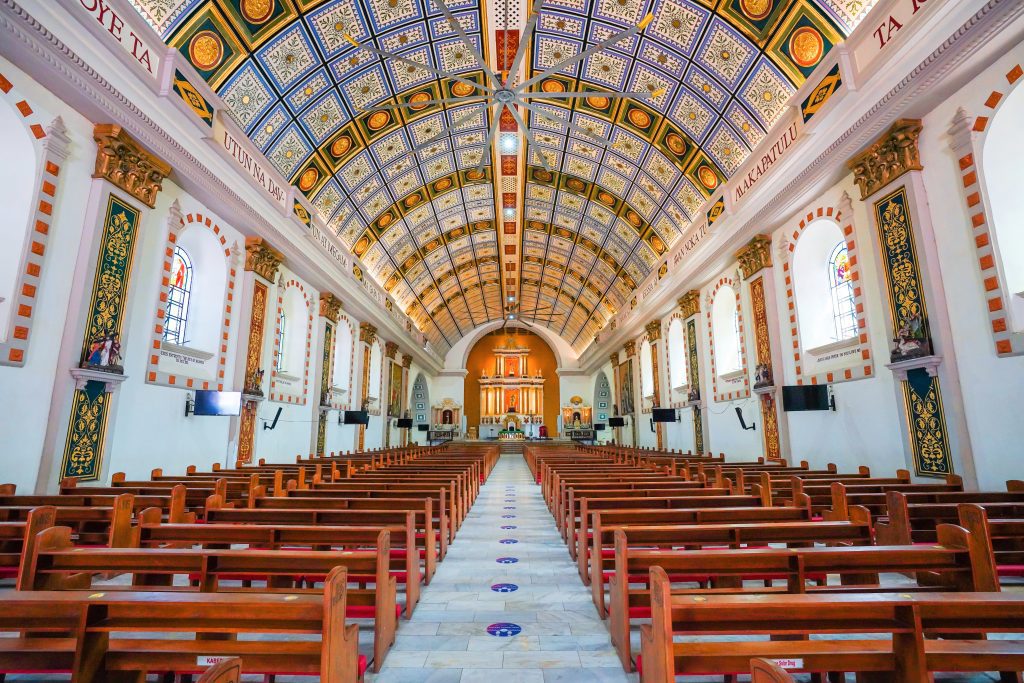
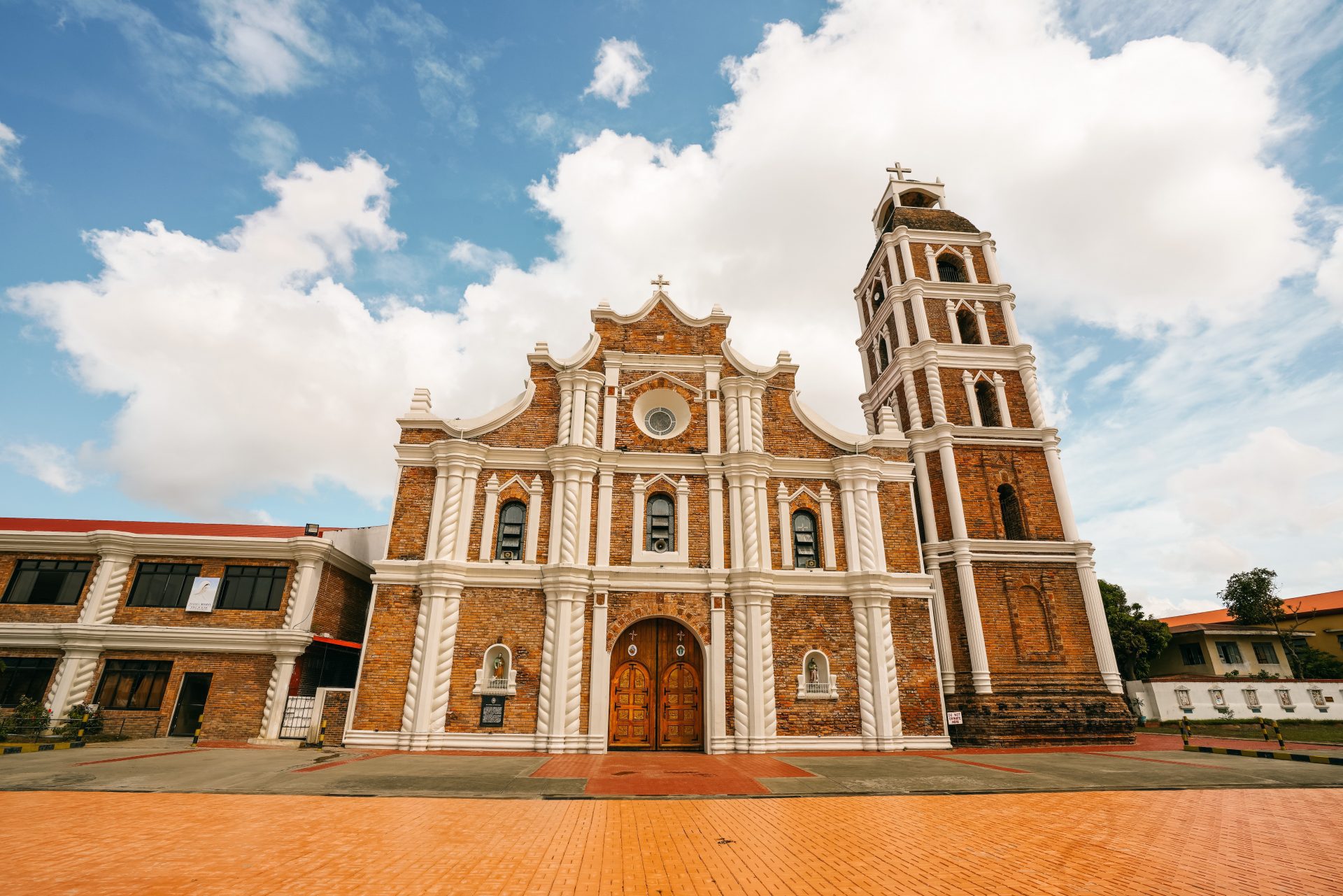
 The 18th-century Baroque-style St. Peter Metropolitan Cathedral is one of the largest churches in Cagayan Valley. Photo by SinoPinas courtesy of the Department of Tourism.
Every Holy Week, devout Filipino Catholics recall the events leading up to Jesus’ death by crucifixion and his resurrection. Among the many ways Filipinos do it is through a practice called Visita Iglesia.
Initially, the purpose of the tradition, which dates back to a 16th century Roman tradition of St. Philip Neri, was to honor the Blessed Sacrament. It later morphed into a form of pilgrimage and meditation for the Holy Week, as well as a form of seeking penance for sins. Superstition even has it that upon completion of a Visita Iglesia, wishes would be granted.
Filipinos typically honor this Holy Week vow on Maundy Thursday or Good Friday. Some even take this time to explore new places around the country.
For such destinations, Cagayan Valley is not necessarily a first choice, but there’s a good reason for it to be.
A number of its most prominent churches are in the Baroque style architecture fused with local construction techniques and decorations. Specific characteristics include a separate bell-tower and strong buttresses to withstand the powers of earthquakes.
These structures are often considered national cultural treasures. In fact, four Philippine churches in such style were even added to UNESCO’S World Heritage List in 1993.
The region’s Baroque churches still stand to this day, a testament of its durable design and Cagayan Valley’s long history of Catholic faith and devotion. The best part is that these are open to pilgrims.
When in Cagayan Valley during the Holy Week, here are the churches that devout Catholics can visit.
St. Peter Metropolitan Cathedral
Tuguegarao, Cagayan
Right at the heart of Cagayan’s capital, Tuguegarao, is the Baroque-style St. Peter Metropolitan Cathedral.
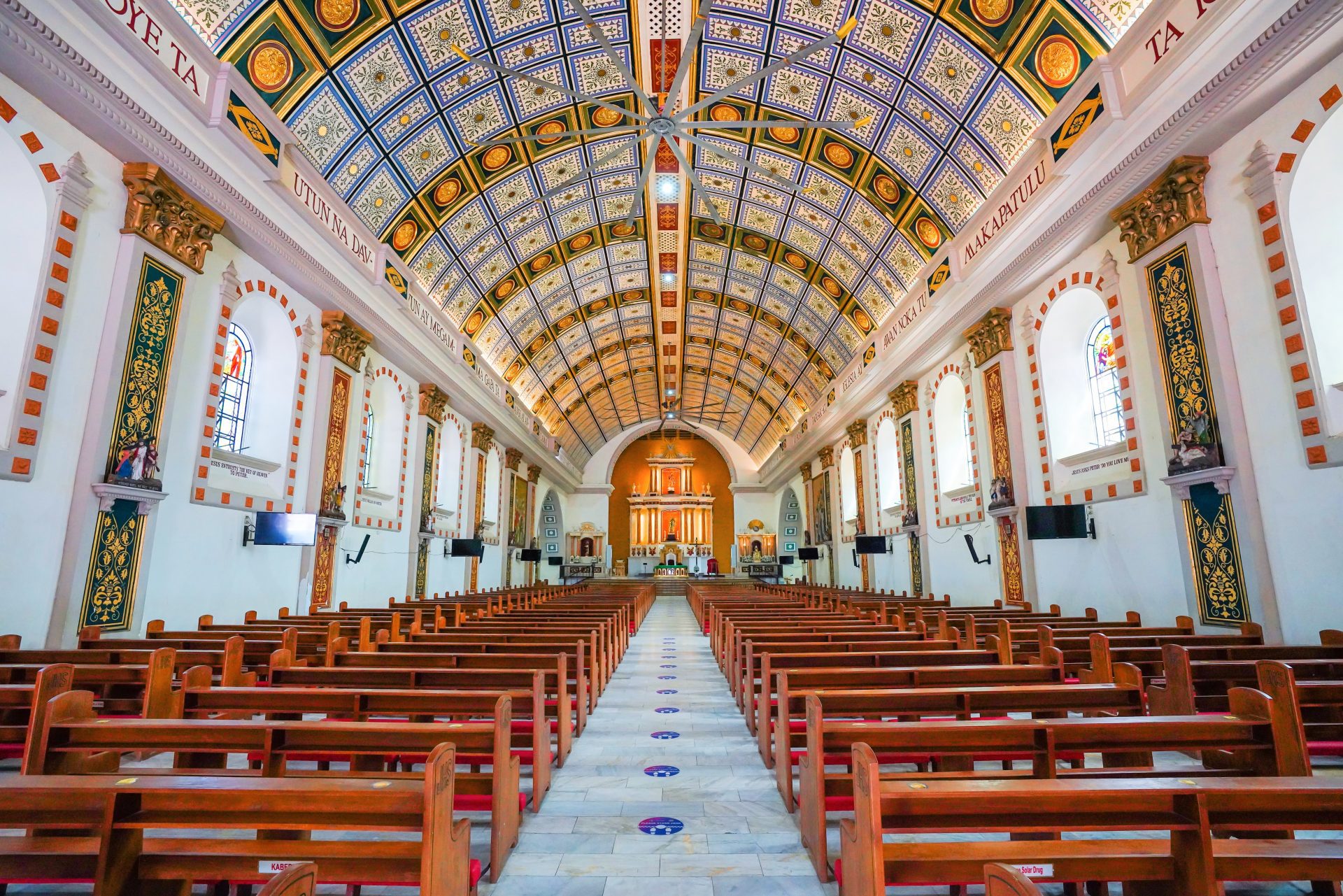 The admirable interior design and ceiling of St. Peter Metropolitan Cathedral . Photo by SinoPinas courtesy of the Department of Tourism.
With Fr. Antonio Lovato, a Spanish Dominican missionary at the helm, the church was built for six years, from 1761 to 1767. The 17-meter wide, 50-meter long, and 50-meter high cathedral comes with a 40-meter belfry.
“It is built with bricks prepared in a horno or a brick oven,” says Rev. Bernard Corpuz, director and parish priest of the St. Peter’s Metropolitan Cathedral. “According to witness accounts, people would line up and pass each brick until it reaches the cathedral for easier construction work.”
Parts of the Baroque-style cathedral were damaged during World War II, including the facade and the belfry. After the war, restoration work soon started and “the picture of the cathedral when it was originally built looked the same after.”
As the mother church of the archdiocese of Tuguegarao, St. Peter’s Metropolitan Cathedral has a cathedra, a raised throne placed behind the altar. It’s often called the bishop’s throne, too, which symbolizes his teaching authority.
In true fusion Baroque architectural style, the church’s ceiling features Matthre 16:8, “Thou art Peter and upon his rock I will build my church; and the gates of hell shall not prevail against it,” in the local dialect.
St. Peter’s Metropolitan Cathedral is open to pilgrims when there are scheduled masses. Upon obtaining permission, visitors can also come in on days that the church is closed.
Basilica Minore of Our Lady of Piat
Piat, Cagayan
One of the eighteen minor basilicas in Cagayan, the shrine of Basilica Minore de Nuestra Señora de Piat is considered the Pilgrimage Center of Northeast Luzon. It’s where the centuries old figure of Our Lady of Piat is located and is the purpose of the visit of thousands of devotees and tourists.
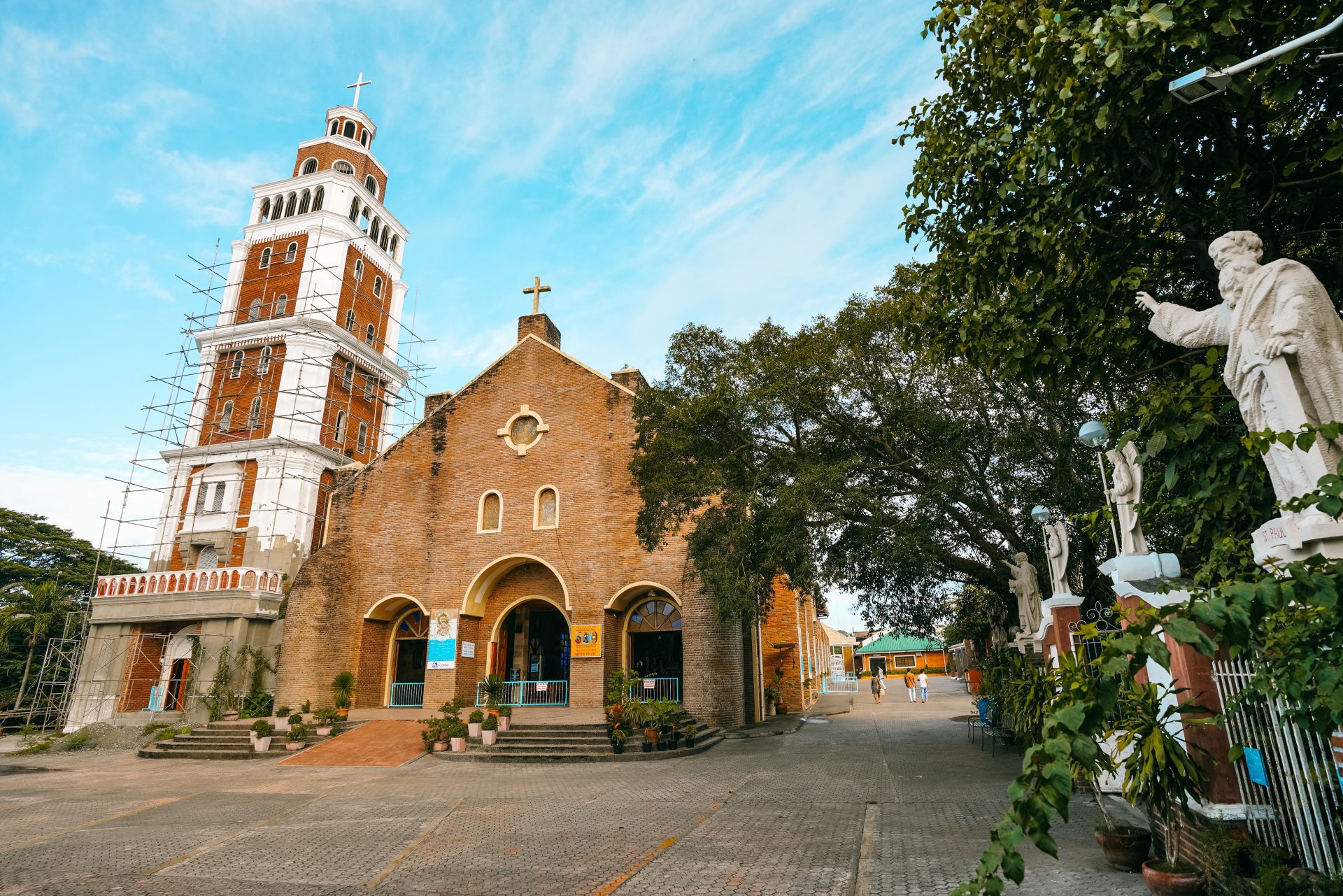 The simple facade of the Basilica Minore of Our Lady of Piat made of red bricks. Photo by SinoPinas courtesy of the Department of Tourism.
I ts history dates back to 1604 when the Dominican friars brought from Macau a black image of the Virgin Mary with the infant Jesus. It was initially called Nuestra Senora del Santisimo Rosario or Our Lady of the Holy Rosary.
At the time, the friars were having difficulty settling down in the area because of the local Itawis who were clannish and always at war. To pacify the locals, the Dominicans then presented the image of the dark-skinned Virgin Mary to convince the people that they have a common mother, and that they are all brothers and sisters in Christ and that is why it’s called ‘a mother to us all.’
“The people fell in love with the image, perhaps because of the dark complexion,” says Fr. Fredel Agatep, rector of the Basilica Minore of Our Lady of Piat. ‘If you look at the Blessed Mother here. She looked exactly like one of the natives.”
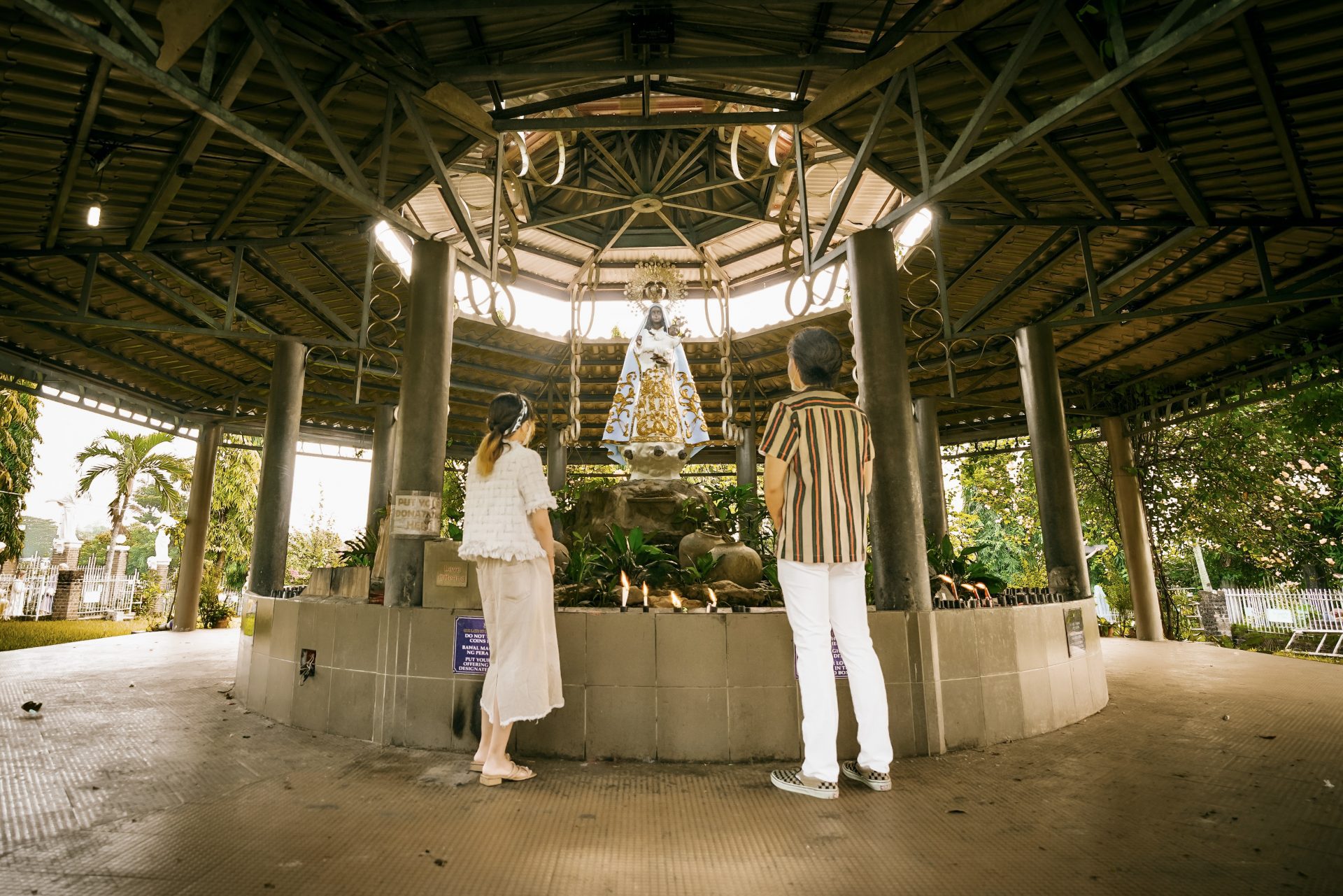 Pilgrims visiting the image of Basilica Minore of Our Lady of Piat. Photo by SinoPinas courtesy of the Department of Tourism.
In just 25 years of evangelization work, the image attracted thousands of pilgrims. “She was the lady who converted the first Christians in Cagayan,” Agatep adds.
From a small sanctuary, a more spacious church was built in the 1700s. Rev. Fr. Diego Pinero later built a new sanctuary, while Fr. Jose Gurumeta restored it in 1875.
But it was only in 1999 that the Vatican elevated the church to its current status as a minor basilica, the first in the region and only the fourth in the Philippines at the time.
Located on top of a hill to avoid the seasonal overflowing of the Chico River, the Baroque-style church–made out of red bricks–has a simple facade with a tall belfry on the left.
Inside, the wood ceiling bears historical images and accounts. At the altar, the Blessed Virgin Mary can be seen in a glass case. A staircase accessed from the back of the church leads to a window behind the image. Here, devotees can touch the dress of Our Lady of Piat.
Within the compound, a Piat Basilica Museum houses artifacts related to the Basilica or Our Lady of Piat. There’s also a surrounding garden-like sanctuary, the parish convent, and life-sized Stations of the Cross.
Unlike pre-pandemic when thousands flocked to the church 40 kilometers outside Tuguegarao, masses these days are only at a limited capacity and socially-distances, or conducted entirely online. Visitors are welcome all-week long, during the morning or afternoon masses.
Parish Church of Saint Rose of Lima
Gamu, Isabela
The humble town of Gamu in central Isabela may not be as bustling as the nearby Ilagan City and Cauayan, but it has the most number of Roman Catholic churches in the entire province.
Its most known church is the Baroque-style Saint Rose of Lima Church. Built in the 18th century, the town’s oldest church’s distinct feature is its facade’s pointed towers. Like most churches in such architectural style, the church also features a belfry on its left.
Inside the church is a standard altar with a life-size image of the Dominican saint it is dedicated to, Saint Rose of Lima.
Born Isabel Flores de Oliva, Saint Rose was a nun in Lima, Peru. Officially the patron saint of embroidery, gardening, and cultivation of blooming flowers, she was known for her life of penance and for caring for the poverty-stricken. Every August, the locals celebrate her life and hold a festival to honor her.
San Pablo de Cabigan Church Ruins
San Pablo, Isabela
Built in 1624 with Dominican Fr. Pedro de Santo Tomas at the helm, the San Pablo de Cabigan Church Ruins is said to be the oldest in the province. Its lofty bell tower of six layers is the tallest in the Cagayan Valley. Unlike most churches in the region, which are made out of red bricks, the church was built using adobe.
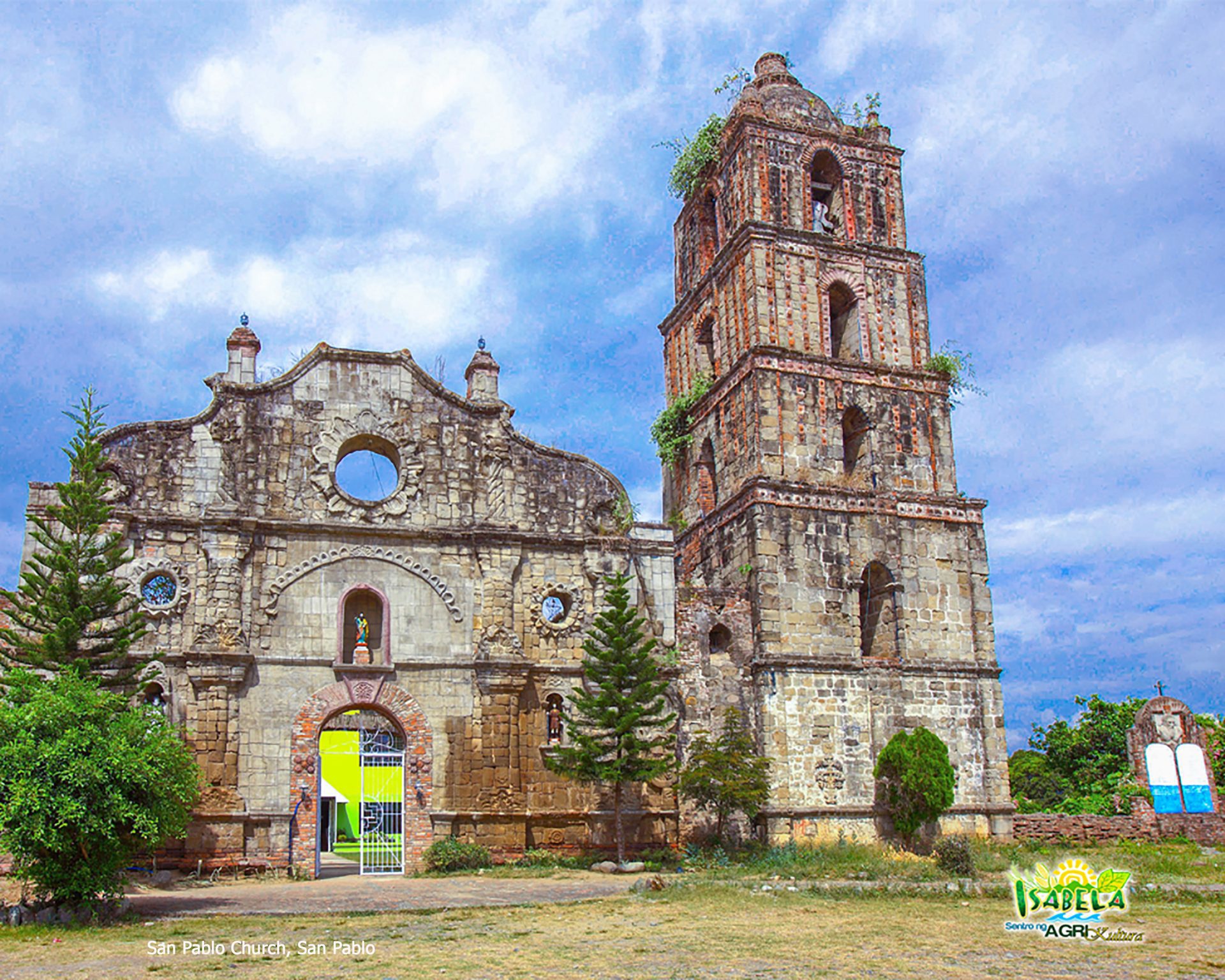 The San Pablo church is the oldest church in Isabela and is made of Adobe instead of red bricks.
Fr. Diego de la Torre built the present structure in 1709 but is now in ruins after being damaged during World War II and an Intensity 7 earthquake in 1949. A fire also destroyed the church’s roof three years later.
Within the ruins, there’s a garden and a smaller church—a third of the original structure—built in the 1950s. This is where masses are still held
The church’s Baroque-style facade features an arched main entrance with now-defaced icons of St. Vincent Ferrer, St. Paul, and St. Isidore on each side. Beside the church are buttresses that continue to support the structure. Bas relief of foliage from the church ruins remain visible, too.
Its six-storey square bell tower, on the church’s right, is the tallest in the Cagayan Valley. It has blind semicircular arched windows with a dome at the top. Visitors can enter this tower, where the arched support of the choir loft can still be seen.
Parish Church of San Matias
Tumauini, Isabela
The Parish Church of San Matias, also called the Tumauini Church, is a brick, Baroque-style place of worship for devout Catholics in the municipality of Tumauini.
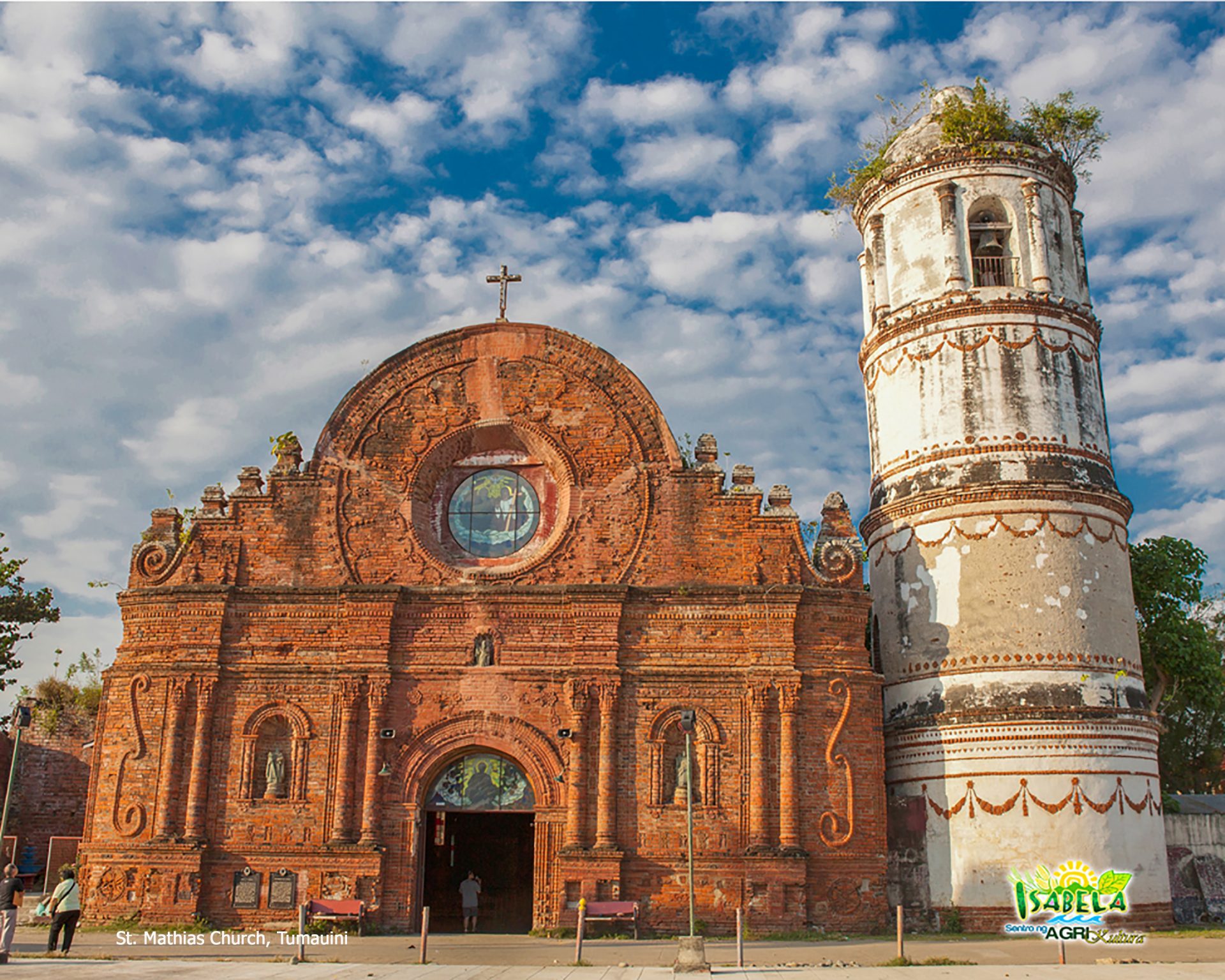 The Parish church of San Matias, also known as the Tumauini Church. Photo by SinoPinas courtesy of the Department of Tourism.
It started out as a church built using nipa and other light materials in 1707 through a Dominican priest, Fr. Francisco Nunez, who dedicated it to Saint Matthias. Another Dominican, Domingo Forto, led the construction of the current church in 1783. It was later continued in 1788 through Fr. Antonio Herrera and eventually completed in 1805. Red bricks were extensively used for it as no good quality stones were available in the area.
The ornately-designed red bricks in the facade and interior walls were thanks to the artisans from Pampanga that Forto hired. The brick facade even shows numbers and dates for the correct sequence of the bricks according to his design.
On the church’s right is a unique tiered cylindrical belfry built in 1805. It is the only known Spanish colonial era cylindrical tower in the Philippines. Meanwhile, the ruins of the church’s clergy house is located on the gospel side of the church.
For its outstanding historical, cultural, artistic or scientific value significant to this country and nation, the National Museum of the Philippines declared the church as a national cultural treasure.
It has even been considered for the 2006 UNESCO World Heritage Tentative List on the extended Baroque Churches of the Philippines.
Parish Church of San Vicente de Ferrer
Dupax del Sur, Nueva Vizcaya
At Nueva Vizcaya’s municipality of Dupax del Sur, another 18th-century Baroque church still stands strong—the Parish Church of San Vicente de Ferrer.
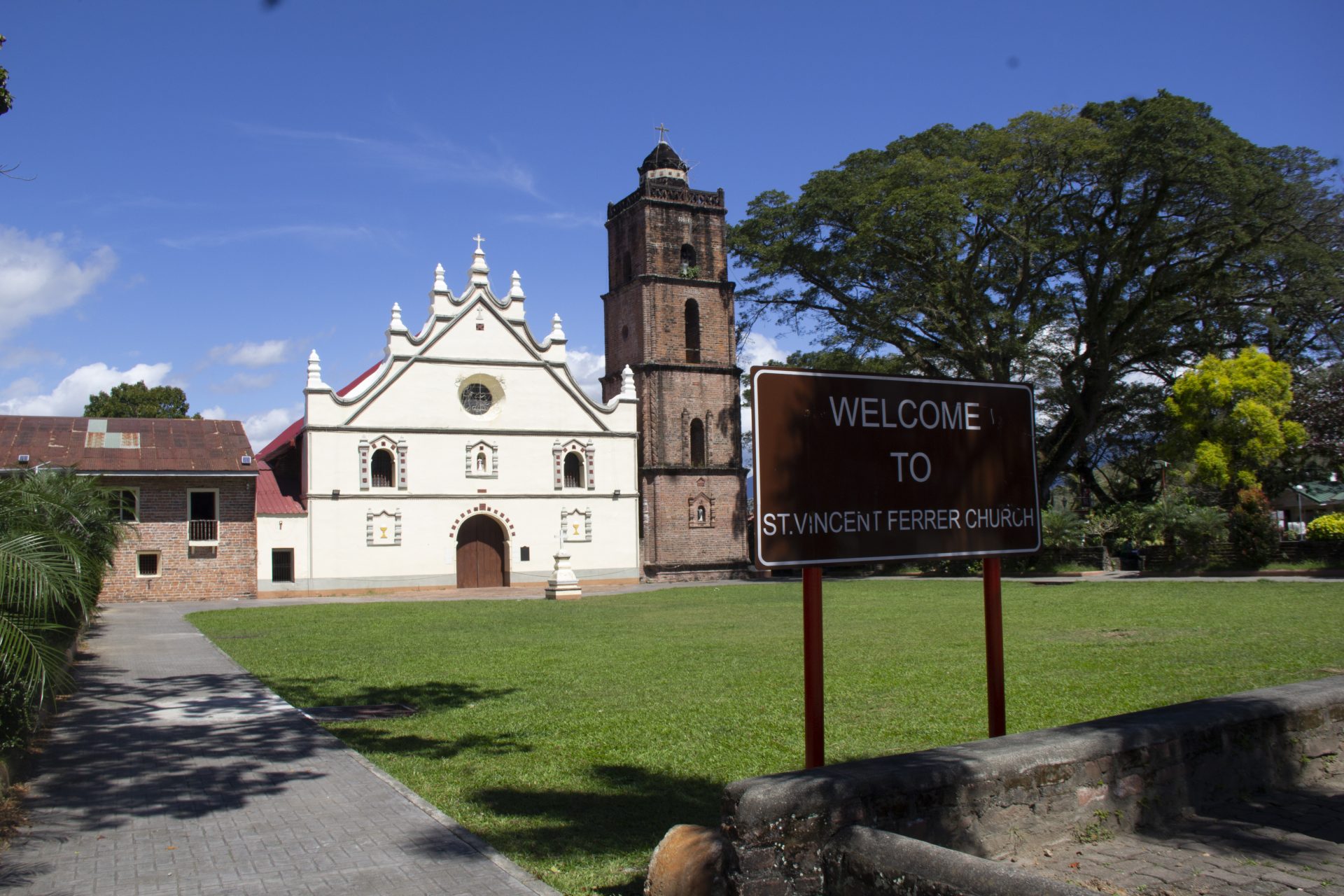 The San Vicente Ferrer Parish Church, located in Brgy. Dopaj, Dupax del Sur, Nueva Vizcaya, Philippines. Photo by SinoPinas courtesy of the Department of Tourism.
Commonly referred to as Dupax del Sur Church, or simply Dupax Church, the church was built as part of the Dominican priests’ mission to convert the local Isinays into Christians at the turn of the 17th century.
The facade is said to be a reflection of the St. Peter’s Metropolitan Cathedral, only simpler. It is divided into horizontal decorative segments of plastered brick. The first level is embellished with clay insets, with two blind windows on each side of the doorway featuring an image of the Holy Eucharist. The second level, meanwhile, has a triangular gable with two sections—one with a circular window and a relief of a cross.
A four-level rectangular bell tower can be seen on the church’s left side with a similar decorative feature as the facade.
Inside, two whitewashed pillars supporting the choir loft show reliefs of cherubs, shells, florals, and arabesques. This motif continues to the baptistery. The images at the altar are believed to be replicas as the original, ivory figures were stolen.
Just like the Tumauini Church, the Dupax church is also a declared national cultural treasure. Like the Tumauini Church, the Dupax Church was also declared a national cultural treasure, making it an absolute must-visit for tourists and pilgrims alike.
St. Dominic Cathedral
Bayombong, Nueva Vizcaya
In Nueva Vizcaya’s provincial capitol of Bayombong stands the St. Dominic Cathedral. The 18th-century, Baroque church is the seat of the Roman Catholic Diocese of Bayombong and was built in 1739 as part of the evangelical mission of Augustinian friars.
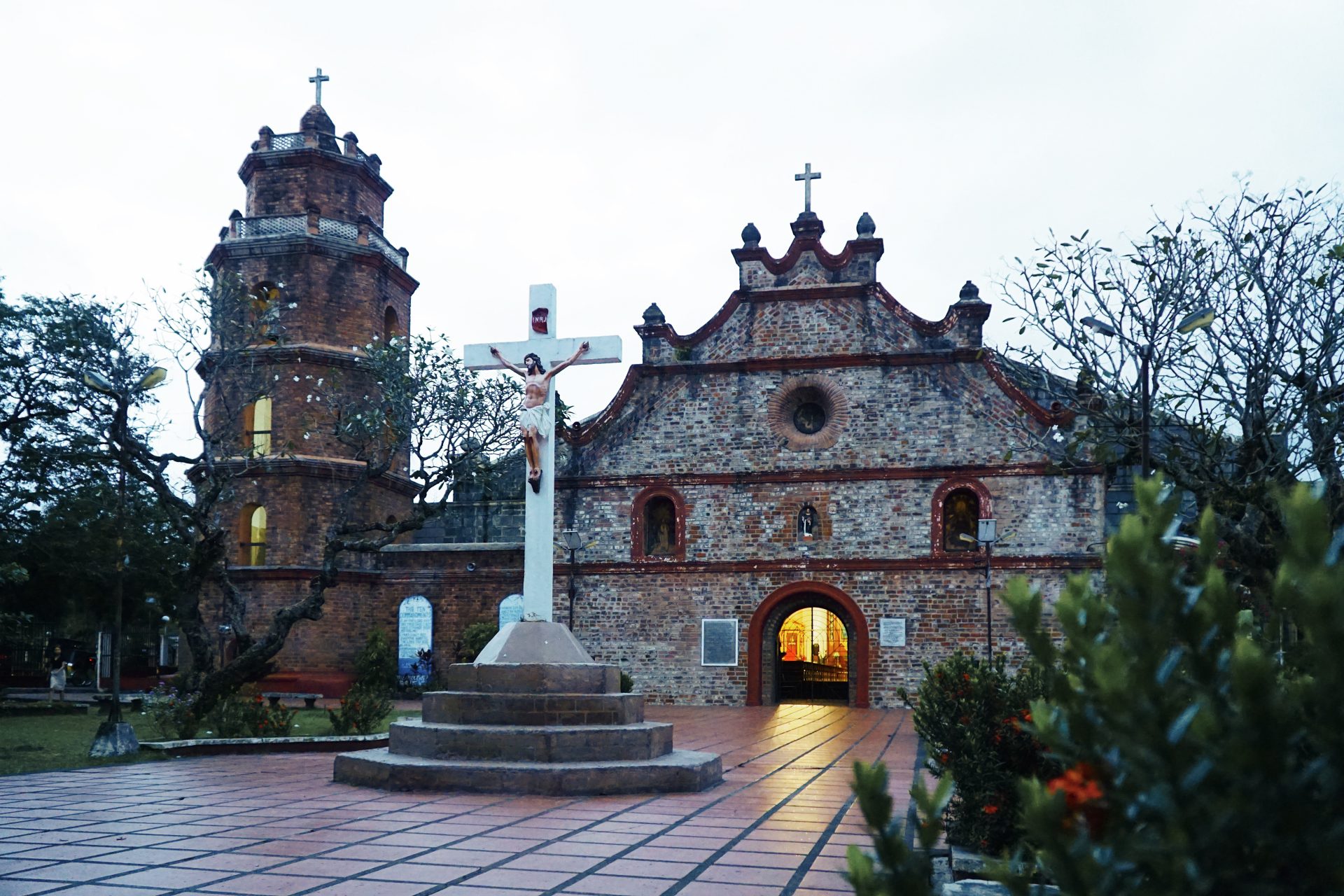 The St. Dominic Cathedral with its slightly detached, octagonal campanile. Photo by SinoPinas courtesy of the Department of Tourism.
Fr. Fray Pedro Freire presided over the first ever mass in what was then called The Church of St. Augustine. A few months later, it was officially dedicated to St. Dominic de Guzman. Though gutted by fire in 1892, reconstruction was completed and in 1895, a galvanized roofing, new altar pieces, and a new pulpit were installed.
The church’s facade is reminiscent of Dupax del Sur Church and the Santa Catalina de Siena Church in Bambang, from its doors, windows, and the shape of its gable. It’s different, however, in that it lacks columns and that its campanile is slightly detached and octagonal in shape.
The facade also has decorative segments dividing it into four segments. There are two windows on the second level on both sides and an oculus on the third level.
St. Dominic’s Cathedral of Bayombong is currently open to visitors, specifically in its socially-distanced, face to face masses.
Outsource the Planning
For a seamless trip, you may leave the planning to DOT’s accredited tour operator in Region 2:
Isabela and Cagayan
[email protected] ; http://pinkdiamondinternational.weebly.com/
Quirino
0916 635 9978; http://www.explorequirino.com/
Nueva Vizcaya
[email protected] ; http://travelesqueph.wordpress.com/
For Department of Tourism-accredited accommodations, visit the official Cagayan Valley Tourism website, region2fun.ph .
Travel safely!
All tourist destinations in Cagayan Valley have health and safety protocols in place to protect locals and visitors alike. Everyone is expected to comply by wearing face masks, regularly washing their hands, and practicing physical distancing.
To check out up-to-date information regarding local destinations that are open and the safety protocols and requirements needed for each location, you may visit www.philippines.travel/safetrip or download the Travel Philippines app at app.philippines.travel or the Google Playstore.